Searching on Google is the starting point of purchasing in the digital age, because users no longer go directly to websites like they did in the past. Instead, they begin by searching for problems such as “Where should I buy it?”, “How much does it cost?”, or “Are the reviews good?” Today, more than 80% of consumers use search engines before deciding to buy a product or choose a service.
That means if a website does not appear on the first page, the business will not even be included in the comparison during the decision-making process. Users usually choose from only the first 3–5 websites they see. So getting a website onto the first page is not just about traffic, but about “having a presence in the online market” and becoming a major channel for acquiring customers in the long term.
This article explains everything from what SEO is, how it actually works, and how ranking mechanisms function, all the way to how to choose a service provider, so you can understand the full picture before deciding to hire an SEO agency and understand that ranking is not only about technical execution, but also about business strategy.

What Is SEO, and Why Do Businesses Need to Rank on the First Page of Google?
SEO (Search Engine Optimization) is the process of optimizing a website to align with Google’s algorithm so that the site can appear in organic search results rather than paid ads. Google evaluates websites based on many factors, such as content quality, credibility, user experience, and relevance to the search query.
Google states that websites offering a good user experience, high-quality content, and strong credibility are more likely to achieve better rankings.
In addition, the algorithm tries to understand the user’s “search intent,” not just the words they type. That means good SEO must fully answer the searcher’s question, covering information, trustworthiness, and even helping with the buying decision
-
People start product research on Google before buying
A large number of users rely on search engines to gather information before purchasing online. This behavior is known as the Zero Moment of Truth, where users research, compare, and read reviews before making a decision. As a result, websites that do not appear on the first page are often eliminated from consideration from the beginning. It is not just a loss of traffic, but an immediate loss of sales opportunities.
-
Google rankings directly affect sales
Studies show that the number one result on Google gets significantly more clicks on average than lower-ranking results. This means rankings do not increase visitors in a linear way, but in a multiplied way, because users tend to believe the top results are the most relevant and trustworthy. This directly affects a business’s conversion rate.
-
How is SEO different from Google Ads?
When ads stop, traffic disappears. SEO, on the other hand, is a long-term asset because it can continue bringing visitors even if you pause active work. SEO builds domain authority over time, which helps reduce the cost per visitor more and more, unlike ads where you must keep paying for every click.
What Is an SEO Service, and What Does It Actually Do?
SEO is not just about fixing blog articles. It involves optimizing the entire website, from its structure to its credibility in Google’s eyes.
-
Keyword Research
This means choosing search terms that people actually search for and that are relevant to the business. Google recommends focusing primarily on user needs. This step also includes analyzing search intent to understand whether users want information, comparisons, or are ready to buy, so the right pages can be created to match that intent.
-
Technical SEO
This includes website speed, URL structure, and mobile friendliness, which are all ranking factors. It also covers heading structure, schema, and crawlability so that search engine bots can understand the website correctly.
-
On-Page SEO
Content must answer the searcher’s question, not just stuff keywords, because Google uses the Helpful Content system to evaluate content quality. Good content should cover the topic thoroughly, demonstrate expertise, and be well connected internally across the website.
-
Off-Page SEO
Links from other websites help increase trust, which is one of Google’s main ranking factors. However, link quality matters more than quantity, because Google evaluates the context, relevance, and trustworthiness of the source.
-
SEO Reporting
This involves tracking rankings, traffic, and user behavior through Google Search Console and Analytics. Reports help measure whether the strategy is actually increasing visits and generating real sales.
What Is White Hat SEO, and How Is It Different from Black Hat SEO?
– White Hat SEO
White Hat SEO means doing SEO in line with Google’s guidelines, with a focus on “benefiting users before pleasing the algorithm.” A website should provide real value and help solve the reader’s problem, not be created just to manipulate rankings.
Examples of White Hat SEO practices include:
- Writing content that genuinely answers the searcher’s questions
- Improving website structure so it loads fast and is easy to use
- Using keywords naturally within the right context, not stuffing them in
- Earning links from websites that are genuinely relevant
- Updating articles so they stay current
The result of White Hat SEO services is usually a gradual increase in rankings, but with stronger stability and much lower long-term risk of penalties.
– Black Hat SEO
Black Hat SEO is the attempt to trick the algorithm into thinking a website is high quality when it actually is not. This includes creating content for bots instead of real readers, or generating fake popularity signals, which can fall under Google’s spam policies.
Examples of risky techniques include:
- Stuffing excessive keywords in an unnatural way
- Creating large numbers of duplicate-content pages to target search terms
- Building many links from low-quality sources
- Hiding text to deceive bots
In the short term, rankings may go up, but there is a high chance they can drop sharply when the algorithm is updated.
– Why Websites Get Deindexed
Possible consequences include:
- Traffic disappearing immediately
- Pages no longer being found in search
- A long recovery period even after fixes are made
That is why sustainable SEO should focus on credibility and user experience rather than chasing short-term ranking gains.
Steps to Promote a Website to the First Page of Google
– Analyze the business and competitors
SEO should begin with understanding the market first by analyzing:
- The keywords customers actually use (buy / compare / find information)
- The page structure of top-ranking competitors
- The type of content Google chooses to show (articles / category pages / landing pages)
This step helps define the strategy for what type of pages the website should create to match search intent, rather than just inserting keywords and hoping for rankings.
– Plan the website structure
Create a category structure and page hierarchy that helps bots understand the relationship between content, such as Home → Category → Article → Service, so Google can clearly understand the site’s main topics.
This also includes setting up URLs, breadcrumbs, and internal links to properly distribute ranking value throughout the website.
– Do On-Page SEO
Optimize on-page elements so they align with search queries, such as:
- Titles and headings that match intent
- Content that fully answers user questions
- Internal links connecting related articles
- UX improvements and better time on page
Google places more importance on content that fully answers questions and is easy to read than on stuffing pages with large numbers of keywords.
– Build quality backlinks
Build website credibility through references from other relevant websites to increase the domain’s authority.
Link quality is judged by:
- Content relevance
- Domain trustworthiness
- The context of the link
Not by the number of links alone.
– Maintain rankings and grow traffic
Once rankings start improving, content should be updated, new articles should be added, and information should be improved continuously to maintain those rankings.
SEO is therefore a long-term process, not a one-time task, but an ongoing effort to build trust and topic coverage in Google’s eyes.
How long does it take to get on Google’s first page?
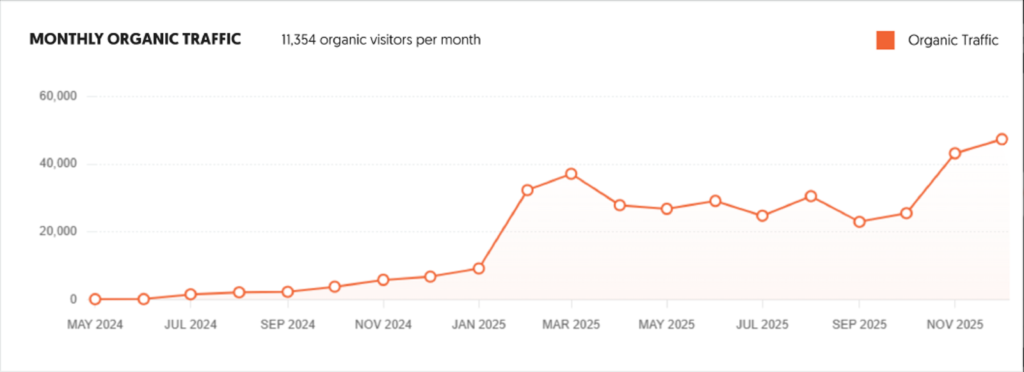
Research shows that many new websites take months or even years to achieve high rankings, because Google needs time to accumulate user behavior data and trust signals before ranking them In general, rankings tend to move in phases rather than rise continuously every day, such as: data collection phase → ranking test phase → stable phase → upward movement phase.
Estimated timeframes (depending on competition)
- Easy keywords: 1–3 months
- Medium-difficulty keywords: 3–6 months
Factors that help rankings improve faster
- Domain credibility: older websites usually have a better chance of ranking faster than new ones
- Keyword difficulty: highly competitive markets require more time
- Content quality: content should be comprehensive and clearly match intent
- Website structure: Google should be able to understand the topic easily
- User signals: time on page and click behavior
User signals: time on page and click behavior
- The website structure is flawed, so bots cannot properly understand the content
- Competitors have stronger authority
- Only part of SEO is done, such as publishing articles without building structure
- The work stops before the algorithm begins to trust the website
Is it better to hire an SEO service or do it yourself?
The decision depends on your resources, time, and how important search is as a customer acquisition channel for your business. If SEO is a major source of leads or sales, having an expert manage it can reduce the risk of building the structure incorrectly from the start, which could otherwise take months to fix later.
You should do it yourself when:
- The website is small and does not have many pages
- The keywords are niche and competition is low
- You have time to learn and experiment
- You are not in a hurry for sales results
Doing it yourself is suitable in the early stage if you want to understand how Google works, but you should accept that experimentation may take a long time before showing real results.
You should hire an SEO provider when:
- The business is in a highly competitive market
- You want serious sales results from Google
- The website has many services or categories
- You want the structure to be set up correctly from the beginning
Hiring help can reduce the cost of mistakes, because if SEO is built on the wrong structure, fixing it may require reworking the entire website, which often takes longer than doing it properly in the first place.
The real cost of SEO
SEO requires time, tools, and expertise. For example, keyword research and competitor analysis tools usually come with monthly costs. In addition, there are ongoing costs for content creation, data analysis, and continuous website improvements. That is why SEO is not a one-time expense, but a long-term process.
How is SEO pricing calculated, and why does it vary from one provider to another?
SEO pricing is based on several factors:
- Keyword difficulty and competition
- The number of website pages that need optimization
- The amount of content that needs to be created
- The depth of analysis and reporting involved
Lower-cost services often cut important steps, such as intent analysis or structural planning, which can lead to slower rankings or results that are not sustainable. In contrast, services with a complete strategy usually take more time and effort, but they are more likely to deliver long-term results.
What needs to be prepared before starting to get a website ranked on Google
Before starting SEO, a website should have a solid foundation in place. Otherwise, ranking improvements may be slow or may not happen at all, because Google evaluates structure, credibility, and user experience together, not just the content alone.
New website vs old website
A new website needs to build credibility first. Google needs time to collect data about user behavior and website quality before it can evaluate rankings.
What a new website should do before seriously starting SEO
- Create a company introduction / about us page
- Provide clear contact information
- Have at least several pages of basic content
- Connect Google Search Console and Analytics
An older website may have an advantage in terms of domain age, but if the structure is wrong, it still needs to be fixed first, because a flawed structure can cause Google to misunderstand the website’s topic.
Does the CMS affect SEO?
The website system does affect SEO, because some systems do not allow important elements to be adjusted, such as URL structure, meta tags, schema, or page speed. A system that allows customization makes it easier for Google to understand the website and helps issues get fixed more quickly.
Examples of elements that should be adjustable
- Title / Meta Description
- Heading Structure
- Sitemap and Robots
- Page speed
- Mobile Responsive
How important is content?
Content is one of the main ranking factors because Google wants to show results that genuinely help searchers solve their problems (Google Helpful Content).
Good content should
- Answer the question completely, not be too short
- Cover the same topic from multiple angles
- Link related articles within the website
Websites that only have landing pages without supporting content usually find it harder to rank than websites with a broader knowledge structure around the topic.
Why it is important to choose an SEO provider that truly understands the business
Good SEO should increase sales, not just rankings, because rankings that do not match the right target audience will not lead to real inquiries or purchases.
Google evaluates quality based on user experience and content expertise (E-E-A-T) That means the person doing SEO must understand the business, the customers, and the search intent in order to build pages that match each stage of the decision-making process, rather than simply pushing keywords up the rankings.
SEO is not a short-term expense like advertising. It is a marketing asset that builds website credibility over time. As time passes, Google learns from user behavior, content quality, and market relevance, which helps lower the cost per visitor continuously.
The more a website covers its topic thoroughly and earns references from relevant sources, the more stable its rankings become. It can also continue generating customers even if the advertising budget is reduced in the future. This is why many businesses use SEO as a main channel for long-term customer acquisition.
FAQ
1. When will SEO start showing results?
In general, SEO takes several months because Google needs time to collect data and test rankings before showing results more consistently. In the early stage, rankings may go up and down, which is normal, before becoming more stable as the system gains more trust in the website. The timeline therefore depends on competition and the quality of the site structure.
2. Is it necessary to create content every month?
Updating existing content and adding new content regularly helps increase the chances of being discovered and maintaining rankings over the long term. Websites that stop updating are often overtaken by competitors that provide fresher information, because Google wants to show up-to-date content to searchers.
3. Can a new website do SEO?
Yes, it can, but it needs time for the system to build trust first. In the beginning, the focus should be on strong structure and high-quality content so Google can clearly understand the website’s topic.
4. Can rankings be guaranteed?
No one can directly control rankings, because Google uses automated algorithms to evaluate results. What can be done is to optimize the website in line with best practices and improve the chances of ranking in a sustainable way.
5. If I stop doing SEO, will rankings drop?
Rankings can change depending on competition and Google’s system updates. Without ongoing maintenance, outdated content and new competitors may cause rankings to decline, so continuous improvement is recommended.